Expectations for the third essay addresses benchmark SS.7HHK.3.4 (Sugar and Plantations)-Describe the development of the sugar industry in Hawaii and economic, political,
and social effects it had on Hawaii. Also, SS.7HHK.3.5 (Sugar and Plantations) Describe the coming of early immigrant groups to Hawaii as contract laborers. . .
We will write a rubric together in class on Monday, November 12, 2012. In addition to the HCPSIII rubric for both benchmarks on my blogspot (below right listed under Standards and Benchmarks), we will re-write the rubrics to include footnotes, bibliography, and other typographical requirements.
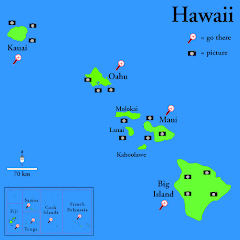
Hawaii
Saturday, November 13, 2010

Friday, November 5, 2010
LESSON 8 - 3rd RESEARCH PAPER
Your third essay discusses King David Kalakaua's trip around the world to recruit labor for its burgeoning sugar industry. The Hawaiian labor shortage could be attributed to diseases that decimated the Hawaiian population. Secondly, Hawaiians considered living on the Ahu'pua'a the perfect place to live in terms of economics (food, shelter, etc) and really did not see the value for coined money. For your project, cull the following information from various websites found under:
King David Kalakaua+immigration+sugar+labor shortage or any variation of these words.
www.hanaumabaydivetours.com/HawaiiHistory.htm
http://www.brasilianculturalcenter.net/wst
http://www.luckyulivehawaii.com/portug.htm
http://www.hawaiiforvisitors.com/oahu/attractions/king-kalakaua-statue.htm
http://www.groups.yahoo.com/group/asianamericanartistry/message/5482
and particularly the text, History of the Hawaiian Monarchy (Rayson, Potter, Kasdon) from Bess Press, 1983. pages 200-204.
Then develop your paper by finishing the following outline of the 3rd term paper for this semester:
Title: Kalakaua and immigration
Topic: King David Kalakaua's trip around the world and his efforts to recruit laborers for Hawai'i's sugar industry.
SS.7HHK.3.4 - Describe the development of the sugar industry in Hawai'i . . .and SS.7HHK.3.5 - Describe the coming of early immigrant groups coming to Hawai'i as contract laborers . . .
(Include footnoting and bibliography referencing)
I. Demand for Sugar
A. Demand for sugar brought demand for labor
1) Hawaiians refused to work because they were used to working on the Ahu'pua'a.
a) Hawaiians had no use for money.
2) The Hawaiian population was decimated because of the introduction of diseases by American, British, and other foreigners.
B. Kalakaua decided to take a trip around the world.
1) To study immigration.
II. Immigration
A. Inequities on the job
1) Underpaid
2) Overworked
B. Cultural Practices
1) Religion
2) Knowledge
III. Immigrant groups needed to adjust or assimilate or acculturate into the Hawaiian culture.
Go to websites to verify and corroborate all the above.
Bibliography style: University of Chicago (Turabian)
Required: 1) Footnotes,
2)Bibliography page,
3) Cover Sheet,
4) Page number (except Cover Sheet - it is considered page 1 but not typed),
5) Spell-Check,
6) double-spaced and two spaces after the end of each sentence, typed in black ink.
King David Kalakaua+immigration+sugar+labor shortage or any variation of these words.
www.hanaumabaydivetours.com/HawaiiHistory.htm
http://www.brasilianculturalcenter.net/wst
http://www.luckyulivehawaii.com/portug.htm
http://www.hawaiiforvisitors.com/oahu/attractions/king-kalakaua-statue.htm
http://www.groups.yahoo.com/group/asianamericanartistry/message/5482
and particularly the text, History of the Hawaiian Monarchy (Rayson, Potter, Kasdon) from Bess Press, 1983. pages 200-204.
Then develop your paper by finishing the following outline of the 3rd term paper for this semester:
Title: Kalakaua and immigration
Topic: King David Kalakaua's trip around the world and his efforts to recruit laborers for Hawai'i's sugar industry.
SS.7HHK.3.4 - Describe the development of the sugar industry in Hawai'i . . .and SS.7HHK.3.5 - Describe the coming of early immigrant groups coming to Hawai'i as contract laborers . . .
(Include footnoting and bibliography referencing)
I. Demand for Sugar
A. Demand for sugar brought demand for labor
1) Hawaiians refused to work because they were used to working on the Ahu'pua'a.
a) Hawaiians had no use for money.
2) The Hawaiian population was decimated because of the introduction of diseases by American, British, and other foreigners.
B. Kalakaua decided to take a trip around the world.
1) To study immigration.
II. Immigration
A. Inequities on the job
1) Underpaid
2) Overworked
B. Cultural Practices
1) Religion
2) Knowledge
III. Immigrant groups needed to adjust or assimilate or acculturate into the Hawaiian culture.
Go to websites to verify and corroborate all the above.
Bibliography style: University of Chicago (Turabian)
Required: 1) Footnotes,
2)Bibliography page,
3) Cover Sheet,
4) Page number (except Cover Sheet - it is considered page 1 but not typed),
5) Spell-Check,
6) double-spaced and two spaces after the end of each sentence, typed in black ink.
LESSON 7-B CONCLUSION
Writing the Conclusion
Here are two samples in writing the conclusion of the term paper concerning foreign arrivals in the 18th and 19th centuries: Today Hawaii is a result of democratic republic, myriad schools and churches, and successful industries.
The fiftieth state developed unique and enduring industries that led the world in innovative products and services.
This is another example: Today Hawai'i has been affected immensely by foreigner arrivals dating back to the late 18th and 19th centuries. In 1820, there was one school in all eight major islands; today there are over 300 along with four major universities. There has been an evolution of industry that depended natural resources while today Hawai'i depends upon people (through tourism and military spending) to fund our tax revenues.
Use the handouts regarding how to write a thesis and conclusion.
Here are two samples in writing the conclusion of the term paper concerning foreign arrivals in the 18th and 19th centuries: Today Hawaii is a result of democratic republic, myriad schools and churches, and successful industries.
The fiftieth state developed unique and enduring industries that led the world in innovative products and services.
This is another example: Today Hawai'i has been affected immensely by foreigner arrivals dating back to the late 18th and 19th centuries. In 1820, there was one school in all eight major islands; today there are over 300 along with four major universities. There has been an evolution of industry that depended natural resources while today Hawai'i depends upon people (through tourism and military spending) to fund our tax revenues.
Use the handouts regarding how to write a thesis and conclusion.
Thursday, October 28, 2010
LESSON 7-A Body of term paper (continued)
Methods of organizing the body section of your paper can be done in these ways: a) Chronological order (time) is effective for sharing personal narratives, summarizing steps, and explaining events, b) Order of location (spatial) is useful for many types of descriptions (e.g., left to right, from top to bottom, etc.), c) Illustration (deductive) is a method of arrangement in which you first state a general idea and then followed with specific reasons, examples, and facts, d) Climax (inductive) is a method of arrangement in which you present details followed by a general statement or a conclusion, e) Compare/Contrast is a method of arrangement in which you compare one subject to another subject, f) Cause-and-Effect is a type of arrangement that helps you make connections between a result and what came before it. Normally, you begin with a general statement giving the cause of something, and then you discuss a number of specific events, g) Problem/Solution is a type of procedure in which you state a problem and explore possible solutions, and h) Definition or classification is a type of arrangement that can be used to explain a term or concept (a machine, a theory, a game, and so on). Begin by placing the subject in the appropriate class, and then provide details that show how your subject is different from and similar to others in the same class.
The first part of the body deals with the political facet: The death of King Kaumuali'i of Kaua'i realigned (divided Kaua'i into several parts) making the Garden Island now part of the Hawaiian Kingdom ruled by King Kamehameha I. But when Kamehameha passes away, his son Liholiho is now heir to the throne.
Liholiho wrote in his will, before traveling to England, that, "my younger brother Kauikeaouli shall be your king."(insert footnote) Unfortunately, Liholiho dowager Queen Victoria Kaumuali'i were inflicted with the measles died in London in 1824. Again, Kaahumanu still acts as Kuhina Nui for the very young Kamehameha III.The second part of the body may be written in this manner as it addresses the social and economic parts of the body:
Foreign influences started the decline of the Hawaiian food supply because of the natives preoccupation with searching for sandalwood. The sandalwood trade became the first industry of Hawaii and Kamehameha the Great wanted to capitalize in enriching Hawaii with an abundance of sandalwood. Thus, Kamehameha II also encouraged the aliis to search for as much sandalwood as possible. This led to the neglect of their farmlands and crops and also destroying their cultural way of life. I must parenthetically add that prior to the sandalwood obsession, the Hawaiians used the barter system and not the use of money. Starvation by untended farms were not the only massacre of indigenous people as foreign ships brought many diseases especially in 1804 and during the reigns the Kamehameha II and III. According to historian Kamakau, ""thousands died, especially in the country districts, of an epidemic of coughs, congested lungs, and sore throat."" (footnote inserted here). But it did not stop with only colds and flus because smallpox, leprosy, and tuberculosis became widespread (prevalent). The seamen had a negative impact upon Hawaiians as these foreign sailors spread their diseases on the Hawaiian population. When law and order was enforced on the drunken visitors, seamen reacted violently. Sailors who knowingly spread contagious diseases ashore they were punished. In addition to spreading contagious diseases, sailors were also fined for carrying dangerous weapons.
The abolition of the Kapu System gave way to the introduction of Christianity. The first missionaries arrived on the ship, Thaddeus, in 1819. The missionaries were given difficult assignments because they built schools, churches, and dwellings in addition to planting in the fields. But the most challenging task was to convert the natives from pagan worship to Christianity and reading the Bible.
Teaching the Hawaiians to read called for a written Hawaiian language to be devised, a printing press, and a school system started.
The rise in mercantilism began with sandalwood trade as Hawaii's first industry. By 1825, whaling took the place of sandalwood as the next industry for Hawai'i.The fur trade cannot be considered to be part of Hawaii's industry because merchants carrying furs on their ships from North America, stopped in Hawai'i to rest and restore their supplies, and then off on their way to China to sell them. Whalers also hired Hawaiians as crewmen. But the boom period of whaling lasted only from 1840 through 1860.
Minor industries such as cattle and salt production were also established in the 1820's. Agricultural production also increased. Also in demand were coffee, pumpkins, cabbages, breadfruit, taro, bananas, arrowroot, melons, pineapples, and firewood.
The need for consuls from England and the United States grew due to increase in trade as Hawaii steadily grew more important as a center for transpacific commerce. By 1840, places such as Hilo and Waimea in Kauai were considered to by towns. Honolulu and Lahaina were already established cities by then.
The first part of the body deals with the political facet: The death of King Kaumuali'i of Kaua'i realigned (divided Kaua'i into several parts) making the Garden Island now part of the Hawaiian Kingdom ruled by King Kamehameha I. But when Kamehameha passes away, his son Liholiho is now heir to the throne.
Liholiho wrote in his will, before traveling to England, that, "my younger brother Kauikeaouli shall be your king."(insert footnote) Unfortunately, Liholiho dowager Queen Victoria Kaumuali'i were inflicted with the measles died in London in 1824. Again, Kaahumanu still acts as Kuhina Nui for the very young Kamehameha III.The second part of the body may be written in this manner as it addresses the social and economic parts of the body:
Foreign influences started the decline of the Hawaiian food supply because of the natives preoccupation with searching for sandalwood. The sandalwood trade became the first industry of Hawaii and Kamehameha the Great wanted to capitalize in enriching Hawaii with an abundance of sandalwood. Thus, Kamehameha II also encouraged the aliis to search for as much sandalwood as possible. This led to the neglect of their farmlands and crops and also destroying their cultural way of life. I must parenthetically add that prior to the sandalwood obsession, the Hawaiians used the barter system and not the use of money. Starvation by untended farms were not the only massacre of indigenous people as foreign ships brought many diseases especially in 1804 and during the reigns the Kamehameha II and III. According to historian Kamakau, ""thousands died, especially in the country districts, of an epidemic of coughs, congested lungs, and sore throat."" (footnote inserted here). But it did not stop with only colds and flus because smallpox, leprosy, and tuberculosis became widespread (prevalent). The seamen had a negative impact upon Hawaiians as these foreign sailors spread their diseases on the Hawaiian population. When law and order was enforced on the drunken visitors, seamen reacted violently. Sailors who knowingly spread contagious diseases ashore they were punished. In addition to spreading contagious diseases, sailors were also fined for carrying dangerous weapons.
The abolition of the Kapu System gave way to the introduction of Christianity. The first missionaries arrived on the ship, Thaddeus, in 1819. The missionaries were given difficult assignments because they built schools, churches, and dwellings in addition to planting in the fields. But the most challenging task was to convert the natives from pagan worship to Christianity and reading the Bible.
Teaching the Hawaiians to read called for a written Hawaiian language to be devised, a printing press, and a school system started.
The rise in mercantilism began with sandalwood trade as Hawaii's first industry. By 1825, whaling took the place of sandalwood as the next industry for Hawai'i.The fur trade cannot be considered to be part of Hawaii's industry because merchants carrying furs on their ships from North America, stopped in Hawai'i to rest and restore their supplies, and then off on their way to China to sell them. Whalers also hired Hawaiians as crewmen. But the boom period of whaling lasted only from 1840 through 1860.
Minor industries such as cattle and salt production were also established in the 1820's. Agricultural production also increased. Also in demand were coffee, pumpkins, cabbages, breadfruit, taro, bananas, arrowroot, melons, pineapples, and firewood.
The need for consuls from England and the United States grew due to increase in trade as Hawaii steadily grew more important as a center for transpacific commerce. By 1840, places such as Hilo and Waimea in Kauai were considered to by towns. Honolulu and Lahaina were already established cities by then.
Wednesday, October 27, 2010
LESSON 7 - RESEARCH (TERM) PAPER - SS.7HHK.3.3 IMPACT OF FOREIGNER'S ARRIVAL
Writing a thesis statement requires that we make well-thought out statements which we will need to substantiate (proof) later when we write supporting details and examples in the body of the term paper. Here is an example of a thesis statement in conjunction to our benchmarks:
The arrival of foreigners in the late 18th and early 19th centuries created an impact upon Hawai'i. The political, social, and economic factors introduced by western influences had both adverse and beneficial effects upon the natives and Hawaiian institutions. Whalers, traders, explorers, and missionaries came to Hawai'i for various reasons and changed Hawai'i irrevocably.
Your thesis statement tells readers specifically what you plan to write about in your paper. It also serves as a personal guide to keep you on track as you research your subject. Your thesis statement takes a stand or expresses a specific feeling or feature of your subject. Set the right tone for your writing. Helpful checklist: 1) identifies a limited, specific subject, 2) focuses on a particular feature or feeling about the subject, 3) is stated in a clear, direct sentence (or sentences), 4) can be supported with convincing facts and details, and 5) meets the requirements of the assignment.
The arrival of foreigners in the late 18th and early 19th centuries created an impact upon Hawai'i. The political, social, and economic factors introduced by western influences had both adverse and beneficial effects upon the natives and Hawaiian institutions. Whalers, traders, explorers, and missionaries came to Hawai'i for various reasons and changed Hawai'i irrevocably.
Your thesis statement tells readers specifically what you plan to write about in your paper. It also serves as a personal guide to keep you on track as you research your subject. Your thesis statement takes a stand or expresses a specific feeling or feature of your subject. Set the right tone for your writing. Helpful checklist: 1) identifies a limited, specific subject, 2) focuses on a particular feature or feeling about the subject, 3) is stated in a clear, direct sentence (or sentences), 4) can be supported with convincing facts and details, and 5) meets the requirements of the assignment.
Friday, October 22, 2010
LESSON 6 - Propaganda and Stereotyping
In pursuit of "Kids Voting" program we need to explore the rational reasons of why we
vote.
Propaganda, stereotyping, and over-generalizations are factors we need to be aware of.
After viewing the films on propaganda, we will attempt to answer questions about why
and how we choose our political leaders.
vote.
Propaganda, stereotyping, and over-generalizations are factors we need to be aware of.
After viewing the films on propaganda, we will attempt to answer questions about why
and how we choose our political leaders.
LESSON 5 - How to Write a Research (Term) Paper
The three elements of writing a Research (Term) paper consists of: 1) Thesis (or Introduction), 2) the Body (mid-section of the paper), and 3) Conclusion.
For our benchmark SS.7HHK.3.3 (Explain the reasons why foreigners came to Hawai'i and explain the political, social, and economic impact on Hawai'i.
I will give you an example of a thesis statement: The arrival of foreigners in the late eighteenth and early nineteenth centuries created an impact upon Hawai'i. The political, social, and economic factors introduced by western influences had an adverse (and a few beneficial) effects upon the natives and Hawaiian institutions. Whalers, traders, explorers, and missionaries came to Hawai'i for various reasons and forever changed Hawai'i.
The body of the term paper is where the supporting statements and examples are placed. The following is an outline of the body:
I. Social
A. Foreigners brought diseases to Hawai'i.
1) Diseases killed thousands of Hawaiians each month over many decades.
a) Leprosy, smallpox, tuberculosis, etc.
B. Introduction of Christianity
1) Converted natives from polytheism to monotheism.
C. Kapu System ended
1) Kaahumanu and Liholiho ordered the burning of the heiaus.
a) Liholiho and Kauikeaouli broke the Kapu defying tradition of dining.
II. Political
A. Kamehameha the Great passes and the political order is changed.
1) Liholiho is heir to the throne.
a) Kaahumanu was chosen as Kuhina Nui (Prime Minister)
to assist Liholiho (now Kamehameha II) to make decisions.
III. Economic
A. The rise of mercantilism.
1) Kamehameha I introduced two bona fide industries to Hawai'i.
a) Sandalwood trade
b) Fur trade.
Definition of "institution" - an institution is any structure of social order governing behavior of a
set of individuals. This applies to customs and behavior patterns.
Homework: Attempt to write sentences to complete the body section of the term paper.
We will explore ways of how to write a conclusion next week.
For our benchmark SS.7HHK.3.3 (Explain the reasons why foreigners came to Hawai'i and explain the political, social, and economic impact on Hawai'i.
I will give you an example of a thesis statement: The arrival of foreigners in the late eighteenth and early nineteenth centuries created an impact upon Hawai'i. The political, social, and economic factors introduced by western influences had an adverse (and a few beneficial) effects upon the natives and Hawaiian institutions. Whalers, traders, explorers, and missionaries came to Hawai'i for various reasons and forever changed Hawai'i.
The body of the term paper is where the supporting statements and examples are placed. The following is an outline of the body:
I. Social
A. Foreigners brought diseases to Hawai'i.
1) Diseases killed thousands of Hawaiians each month over many decades.
a) Leprosy, smallpox, tuberculosis, etc.
B. Introduction of Christianity
1) Converted natives from polytheism to monotheism.
C. Kapu System ended
1) Kaahumanu and Liholiho ordered the burning of the heiaus.
a) Liholiho and Kauikeaouli broke the Kapu defying tradition of dining.
II. Political
A. Kamehameha the Great passes and the political order is changed.
1) Liholiho is heir to the throne.
a) Kaahumanu was chosen as Kuhina Nui (Prime Minister)
to assist Liholiho (now Kamehameha II) to make decisions.
III. Economic
A. The rise of mercantilism.
1) Kamehameha I introduced two bona fide industries to Hawai'i.
a) Sandalwood trade
b) Fur trade.
Definition of "institution" - an institution is any structure of social order governing behavior of a
set of individuals. This applies to customs and behavior patterns.
Homework: Attempt to write sentences to complete the body section of the term paper.
We will explore ways of how to write a conclusion next week.
Subscribe to:
Posts (Atom)