In pursuit of "Kids Voting" program we need to explore the rational reasons of why we
vote.
Propaganda, stereotyping, and over-generalizations are factors we need to be aware of.
After viewing the films on propaganda, we will attempt to answer questions about why
and how we choose our political leaders.
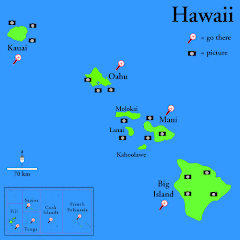
Hawaii
Friday, October 22, 2010

LESSON 5 - How to Write a Research (Term) Paper
The three elements of writing a Research (Term) paper consists of: 1) Thesis (or Introduction), 2) the Body (mid-section of the paper), and 3) Conclusion.
For our benchmark SS.7HHK.3.3 (Explain the reasons why foreigners came to Hawai'i and explain the political, social, and economic impact on Hawai'i.
I will give you an example of a thesis statement: The arrival of foreigners in the late eighteenth and early nineteenth centuries created an impact upon Hawai'i. The political, social, and economic factors introduced by western influences had an adverse (and a few beneficial) effects upon the natives and Hawaiian institutions. Whalers, traders, explorers, and missionaries came to Hawai'i for various reasons and forever changed Hawai'i.
The body of the term paper is where the supporting statements and examples are placed. The following is an outline of the body:
I. Social
A. Foreigners brought diseases to Hawai'i.
1) Diseases killed thousands of Hawaiians each month over many decades.
a) Leprosy, smallpox, tuberculosis, etc.
B. Introduction of Christianity
1) Converted natives from polytheism to monotheism.
C. Kapu System ended
1) Kaahumanu and Liholiho ordered the burning of the heiaus.
a) Liholiho and Kauikeaouli broke the Kapu defying tradition of dining.
II. Political
A. Kamehameha the Great passes and the political order is changed.
1) Liholiho is heir to the throne.
a) Kaahumanu was chosen as Kuhina Nui (Prime Minister)
to assist Liholiho (now Kamehameha II) to make decisions.
III. Economic
A. The rise of mercantilism.
1) Kamehameha I introduced two bona fide industries to Hawai'i.
a) Sandalwood trade
b) Fur trade.
Definition of "institution" - an institution is any structure of social order governing behavior of a
set of individuals. This applies to customs and behavior patterns.
Homework: Attempt to write sentences to complete the body section of the term paper.
We will explore ways of how to write a conclusion next week.
Thursday, October 7, 2010
LESSON 4 - ECONOMICS - RESOURCES, MARKETS, AND GOVERNMENT
The more I read about Kamehemeha I, the more I've become fascinated by Kamehameha's great intellect. Although the complexity of his strategies made him great, it was his simplicity which we regard as a genius. The first king of modern Hawai'i served his people by being astute, kind, and with integrity. It was from Kamehameha's wisdom that introduced sandallwood and fur as Hawaii's first industries. Studying Kamehameha brings us now to a new benchmark: SS.7HHK.3.3 - Explain reasons why foreigners came to Hawai'i and explain the political, social, and economic impact on Hawai'i.
Attempting to explain reasons why foreigners came to Hawai'i (SS.7HHK.3.3) invariably includes describing how prices and products were affecting consumers and producers in this era (late 18the through early 19th century Hawai'i). We will correlate the Role and Function of Markets (SS.7HHK.8.1) and the first industries of Hawai'i - namely, the Sandalwood and Fur Trade.
As a precursor in understanding these required benchmarks, we will study economic theory. When you begin to create your economics blogspot, you will be required to know the fundamentals of:1) Law of Supply and Demand,
2) Opportunity Cost and Substitutability,
3) General Equilibrium and the Price System,
4 ) Elasticity and Inelasticity,
5) the Law of Diminishing Marginal Utility,
6) Inflation and Unemployment,
7) Balance of Trade
8) Contrasting the Free Market System with Socialism and Communism, and
9) Monopolies and Oligopolies.
In producing your blogspot, I will require the following:
1) weekly, monthly, or quarterly statistics (tracked by graphs or charts) on:
a) Dow Jones Averages and NASDAQ for each day,
b) unemployment figures for the week (national),
c) inflation rate (national),
d) currency values (dollar vis-a-vis euro),
e) price of crude oil, and
f) vocabulary words relating to economics with a corresponding sentence.
Log onto this blogspot: http://kalakauaecon-gwong.blogspot.com/
Tuesday, September 7, 2010
LESSON 3 - UNIFICATION OF THE HAWAIIAN ISLANDS
The required work for the unification of the Hawaiian Isles will be judged on the results of your booklet. There are three benchmarks that we are addressing: SS.7HHK.3.1 - Explain the events (including warfare and land control), people (including Kamehameha, Kekuhaupio, Kalaniopu'u, Kiwala'o, Keoua, Keawemauhili, Kahekili, Kalanikupule, Davies, and Young), and ideas (including foreign advisores, weaponry, and stategies) that led to the unification of the Hawaiian Islands., 2) SS.7.HHK.1.1 - Analyze both change and continuity during unification and the monarchy period. With this benchmark, the student compares ideas (e.g., kapu system), technology (e.g., firearms, ships), and people, foreign advisors) that led to major changes during the unification and monarchy period. The last benchmark, SS.7.HHK.3.2 asks you to describe the effects of unification including the establishment of monarchy, peaceful rule of Kamehameha, Mamalahoe Kanawai, the organization of government, and rebuilding of resources. Hence, we study Kamehameha's peaceful rule of the islands. You need to include the re-building of war torn Hawaii, the cultivation of taro lands, and taxation.
Your booklet will be judged using a special rubric (see Class Links). After you have culled your data, you may want to look into George Orwell's 6 Rules for Writing - See http://www.writingclasses.com/informationPages/index.php/PageID300 or http://grammar.about.com/od/writeronwriting/a/OrwellRules.htm
After you cull your information, it would be a good idea to organize your data by outline or through the use of graphic organizers (see http://www.cls.utk.edu/pdf/keys_Id/appendix_E.pdf)
For the lessons on Tuesday (9/4), Thursday (9/6), and Friday, (9/7) you will meet in the Computer Lab and research as many Internet websites related to Kamehameha's unification and also Kamehameha's peaceful rule since the booklet you are assimilating also include SS.7HHK.3.2 and SS.7.HHK.1.1 (see the Standards and Benchmarks under Class Links on this blogspot.
To augment the production of your booklet, you might want to create a time-line followed by your sentences and paragraphs fully describing the unification, Kamehameha's peaceful rule, and the establishment of the monarchy.
An excellent text to paraphrase is A. Grove Day's pamphlet entitled, Kamehameha - Hawaii's First King. Remember that the City of Refuge and the Battle of Moku'ohai located on the Big Island are in close proximity to each other.
Requirements for your booklet: (1) typed - text should be font size 12, (2) Title and sub-title are bold-faced at font size 14 or 16, (3) the Bibliography should be the last page of your booklet, your bibliography contains (in this order): Author Last name, First name, Title of publication, publisher, year of publication, city of publication, and page number(s). See Turabian Style of Annotation for more regarding bibliography.
Sunday, August 15, 2010
LESSON 2 - MIGRATION
In this lesson, we encounter various theories of how the native Hawaiians immigrated to Hawai'i. Most of the history of Hawaiian migration will never be known, but anthropologists and historians have fitted pieces together until we can see at least the outlines of an incredible history of the sea.
It is imperative that you categorize the Pacific Ocean, known as Oceania, into three parts: Melanesia, Micronesia, and Polynesia. In this chapter, it will become known to you that there were two waves of migration into Hawai'i. The first wave occured around 500 AD (or C.E.) while the second wave came about the year 1000 A.D.
Reknown navigator Thor Heyerdahl and even recent anthroplogists believe that the migration to Polynesia may even include natives of South America.
Your assignment is to read Chapter 4 and sketch the migration from Southeast Asia all the way to Hawai'i. Include in your drawings arrows to indicate the directions of migration.
You can imagine how well these stalwart Polynesians were superior to European much earlier than the Vikings and Christopher Columbus. Polynesians could navigate over the vast oceans by only using nature (i.e., wind, star navigation, cloud formation, etc.).
LESSON 1 - GEOLOGY OF HAWAI'I
Geology of Hawai'i - Due Thursday, August 16, 2012
Geology of Hawai'i and History Standard 1: Change, Causality, and Continuity, when combined, is a classic example of cause-and-effect relationships. We will examine how the islands were formed and how does the geological system of Hawai'i is unique vis-a-vis other geological systems of the world.
Your assignment is to write and draw the stages of continuing growth of stages of development. The vocabulary helps to understand Hawai'i's development therefore, using the appropriate nomenclature would enhance your knowledge of Hawai'i's evolution.
General Learner Outcomes # 1 and # 4- Quality Producer and Complex Thinker, respectively
are evident after you've completed answering these four questions from "The Hawaiian Monarchy," Chapter 2: (All answers require no more than 3 sentences each).
1) Describe in your own words how the Hawaiian Islands were formed,
2) Explain the "hot spot" theory of island formation. Where is the "hot spot" now?
3) How are coral reefs and atolls formed?
4) What are the continuing stages of island growth and what stage are the Hawaiian Islands now in?
Also, answer the question in the Activities for Enrichment section by drawing and captioning
your answer: #4) Draw the formation of an island chain showing the successive stages of development.
You may also use the text, "Pacific Nations and Territories," (1995, Riley Ridgell) and Atlas of Hawaii (1983) to help illustrate any one of your answers.
Apply the criteria listed under Social Studies Rubric in the Class Links section
Differentiated Lesson: answer all fill-in questions on the Chapter Two worksheet (Hawaiian Monarchy workbook, pages 3-4).
All Classes: define all Word Wall definitions by August 23, 2012. See Word Wall Cumulative in the Class Links section of this blogspot.
Subscribe to:
Posts (Atom)