Colonization under British rule was similar to annexation of the Hawaiian Isles, French Polynesia, Tonga, and Fiji. Apply Benchmark SS.7PI.3.1 (Explain why foreigners came to Oceania and examine the resultant political, social, and economic impact on the indigenous people) to the Honolulu Advertiser news article entitled, Raid on Maori village ignites furor, and write a two-paragraph paper stating: ( 1) the facts or summary of the article, and (2) propose a solution to the problem.
Due Tuesday, May 14, 2013
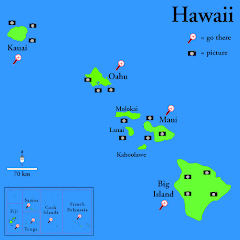
Hawaii
Thursday, February 24, 2011

Thursday, February 3, 2011
LESSON D - LATITUDE AND LONGITUDE
Using the handout about Latitude and Longitude, answer the questions. Due Thursday, February 14, 2013
LESSON C - FRENCH POLYNESIA, FIJI, TONGA, and SAMOA
Using the Reilly Ridgell text book, Pacific Nations and Territories, draw a map of French Polynesia from page 156 and also answer the four questions on page 159. Due Friday, February 8, 2013.
Using the same text, Pacific Nations and Territories, draw a map of Fiji on page 120 for Chapter 23 and answer the questions on page 123. Due Tuesday, February 12, 2013.
Using the same text, Pacific Nations and Territories, draw a combined map of both pages 145 and 146 of Tonga. Answer the questions on page 148. Due Thursday, February 14, 2013.
Using the same text, Pacific Nations and Territories, draw a map of Samoa (a.k.a. Western Samoa)
from page 129. Answer the four questions on page 133. Due Monday, February 18, 2013.
Using the same text, Pacific Nations and Territories, draw a map of Fiji on page 120 for Chapter 23 and answer the questions on page 123. Due Tuesday, February 12, 2013.
Using the same text, Pacific Nations and Territories, draw a combined map of both pages 145 and 146 of Tonga. Answer the questions on page 148. Due Thursday, February 14, 2013.
Using the same text, Pacific Nations and Territories, draw a map of Samoa (a.k.a. Western Samoa)
from page 129. Answer the four questions on page 133. Due Monday, February 18, 2013.
LESSON B - LIBERAL VS CONSERVATIVE
Homework: Due Feb. 1, 2011 - Write definitions of what a liberal is and what a conservative stands for. Look into websites which discusses liberalism and conservatism.
Secondly, write six (6) examples of what a liberal or a conservative is.
(e.g., President John F. Kennedy's proposal to order federal troops on the the
campus of the University of Alabama to assure black students a right to
higher education was a liberal move.)
Secondly, write six (6) examples of what a liberal or a conservative is.
(e.g., President John F. Kennedy's proposal to order federal troops on the the
campus of the University of Alabama to assure black students a right to
higher education was a liberal move.)
Wednesday, January 12, 2011
LESSON A - PACIFIC NATIONS STUDIES
Chapter 1 - Pacific Geology
The theory of plate tectonics, Hawaiian volcanism, and earthquakes are introduced. In addition, the evolutionary continental drift over the last 200 million years are explored in this chapter. See the illustration under the heading - Pangea.
Answer the questions of page 8 and write the definitions of the vocabulary.
Due date: Friday, January 25, 2013.
The theory of plate tectonics, Hawaiian volcanism, and earthquakes are introduced. In addition, the evolutionary continental drift over the last 200 million years are explored in this chapter. See the illustration under the heading - Pangea.
Answer the questions of page 8 and write the definitions of the vocabulary.
Due date: Friday, January 25, 2013.
Friday, December 3, 2010
LESSON 9 - THE GREAT MAHELE
The Hawaiian government under the reign of King Kamehameha III (Kauikeaouli) was financially imperiled. Insolvency of the government placed Kauikeaouli in a dilemma and therefore, the government needed funding from tax revenues and other sources. This situation called for the need to offer sale of government lands to fund the government. Capitalism was now a driving force in the Hawaiian economy. No longer did the feudal system (called the Ahu'pua'a or shared land) exist for natives. Many foreigners bought real estate from the government.
Social Studies benchmark SS.7HHK.3.4 is concerned primarily with the development of the sugar industry. As a precursor to the development of the sugar industry, private companies, who wanted to exploit Hawaiian soil for sugar and pineapple, needed title to the land.
We will perform an actual landmark court case entitled, Oni versus Meek, in the classroom to elucidate the conflict between east and west - between the traditional Hawaiian values vis-a-vis capitalism.
However, the need to organize our thoughts for this benchmark should be noted in an outline.
Instructions: Using the History of the Hawaiian Monarchy text, fill in the missing parts of this outline:
Title: Major Transitions in Hawai'i
I. Describe the development of the sugar industry
A. Demand for Sugar
B. Plantation
1) Capital investments
C. Effects
1) Economic
2) Social
3) Political
II. The Big Five
A. The Establishment
1) AMFAC
2) Theo H. Davies
3) Castle & Cooke
4) C. Brewer
5) Alexander & Baldwin
III. The Great Mahele
A. The traditional (Hawaiian Cultural way of life) versus Free Market System (Capitalism)
1) Define Capitalism
2) The Ahu'pua'a
a) Comparing and Contrasting to the Feudal System.
IV. Immigration
A. Contract Laborers
1) China
B. Relationships
C. Cultures
D. Assimilation or acculturation into the American way of life.
Social Studies benchmark SS.7HHK.3.4 is concerned primarily with the development of the sugar industry. As a precursor to the development of the sugar industry, private companies, who wanted to exploit Hawaiian soil for sugar and pineapple, needed title to the land.
We will perform an actual landmark court case entitled, Oni versus Meek, in the classroom to elucidate the conflict between east and west - between the traditional Hawaiian values vis-a-vis capitalism.
However, the need to organize our thoughts for this benchmark should be noted in an outline.
Instructions: Using the History of the Hawaiian Monarchy text, fill in the missing parts of this outline:
Title: Major Transitions in Hawai'i
I. Describe the development of the sugar industry
A. Demand for Sugar
B. Plantation
1) Capital investments
C. Effects
1) Economic
2) Social
3) Political
II. The Big Five
A. The Establishment
1) AMFAC
2) Theo H. Davies
3) Castle & Cooke
4) C. Brewer
5) Alexander & Baldwin
III. The Great Mahele
A. The traditional (Hawaiian Cultural way of life) versus Free Market System (Capitalism)
1) Define Capitalism
2) The Ahu'pua'a
a) Comparing and Contrasting to the Feudal System.
IV. Immigration
A. Contract Laborers
1) China
B. Relationships
C. Cultures
D. Assimilation or acculturation into the American way of life.
Tuesday, November 16, 2010
LESSON 8-D More websites plus footnoting for Internet Sources
Please check into these websites for more information about sugar contract labor immigration into Hawaii:
www2.hawaii.edu/~jour/history/
http://gohawaii.about.com/od/hawaiianpeople/ss/hawaii_chinese_8.htm
http://eh.net/encyclopedia/article/lacroix.hawaii.history
http://spensaahawaiitravel.blogspot/2009/04/king-david-kalakaua
www.cetel.org/timeline.html
http://naturalhawaii.com/html/hawaiian-history/51-hawaiian-c
To footnote:
Internet: 10William J. Mitchell, City of Bits: Space, Place, and the Infobahn [Book on-line] (Cambridge, Mass. : MIT Press, 1995, accessed 29, September 1995); available from
http://www-mitpress.mit.edu:80/City_of_Bits/Pulling_Glass/index.html; Internet.
Internet: 11Joanne C. Baker and Richard W. Huntsead, "Revealing the Effects of Orientation
in Composite Quasar Spectra," Astrophysical Journal 452:L95-L98, 20 October 1995
[journal on-line]; available from http://accessed 29 September 1995.
Book: Dr. Ann Rayson, Norris W. Potter, and Lawrence M. Kasdon, The Hawaiian Monarchy,
(Honolulu: Bess Press, 1983), 85.
Magazines: 40. Bruce Weber, "The Myth Maker: The Creative Mind of Novelist E.L. Doctorow,
New York Times Magazine, 20 October 1985, 42.
Newspapers: 22 Honolulu Star-Advertiser (Honolulu), 16 June 1905.
For Bibliography page:
Book: Rayson, Ann, Potter, Norris W., and Kasdon, Lawrence M. The Hawaiian Monarchy,
Honolulu: Bess Press, 1983.
To place these footnotes onto the Bibliography Page:
www2.hawaii.edu/~jour/history/
http://gohawaii.about.com/od/hawaiianpeople/ss/hawaii_chinese_8.htm
http://eh.net/encyclopedia/article/lacroix.hawaii.history
http://spensaahawaiitravel.blogspot/2009/04/king-david-kalakaua
www.cetel.org/timeline.html
http://naturalhawaii.com/html/hawaiian-history/51-hawaiian-c
To footnote:
Internet: 10William J. Mitchell, City of Bits: Space, Place, and the Infobahn [Book on-line] (Cambridge, Mass. : MIT Press, 1995, accessed 29, September 1995); available from
http://www-mitpress.mit.edu:80/City_of_Bits/Pulling_Glass/index.html; Internet.
Internet: 11Joanne C. Baker and Richard W. Huntsead, "Revealing the Effects of Orientation
in Composite Quasar Spectra," Astrophysical Journal 452:L95-L98, 20 October 1995
[journal on-line]; available from http://accessed 29 September 1995.
Book: Dr. Ann Rayson, Norris W. Potter, and Lawrence M. Kasdon, The Hawaiian Monarchy,
(Honolulu: Bess Press, 1983), 85.
Magazines: 40. Bruce Weber, "The Myth Maker: The Creative Mind of Novelist E.L. Doctorow,
New York Times Magazine, 20 October 1985, 42.
Newspapers: 22 Honolulu Star-Advertiser (Honolulu), 16 June 1905.
For Bibliography page:
Book: Rayson, Ann, Potter, Norris W., and Kasdon, Lawrence M. The Hawaiian Monarchy,
Honolulu: Bess Press, 1983.
To place these footnotes onto the Bibliography Page:
Subscribe to:
Posts (Atom)